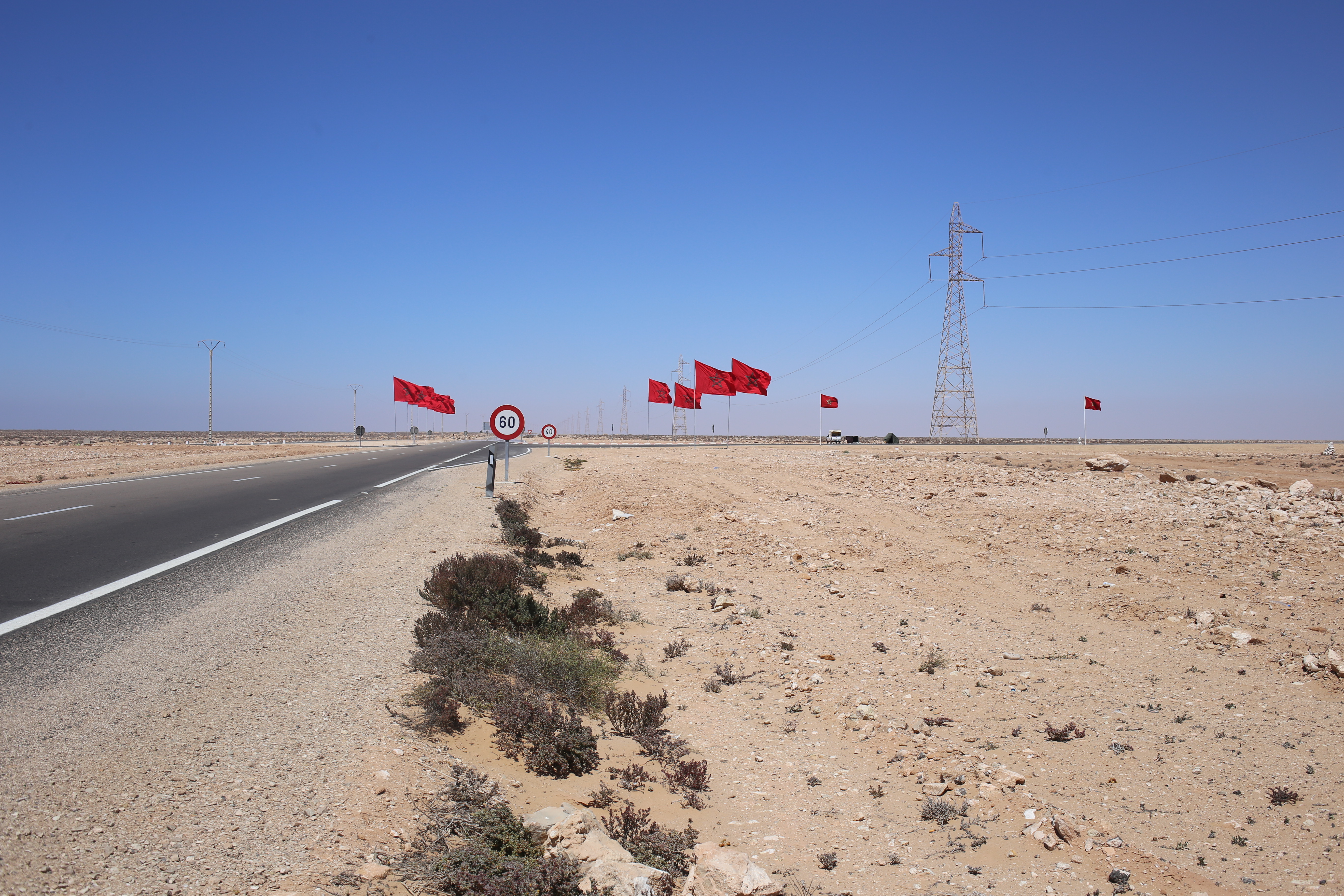
Morocco’s Finance Bill for 2027 reveals that four out of six planned green hydrogen projects are located in occupied Western Sahara.
Photo: @ElliLorz. Moroccan energy infrastructure in occupied Western Sahara.
Morocco’s 2027 Finance Bill, published in late October, provides new details about land allocations for the country’s controversial green hydrogen programme.
The document does not identify the precise sites or link the land allocations to specific projects. But it confirms that preliminary land-reservation contracts have been signed and engineering studies may have begun.
On page 133, the Explanatory Note on the Draft Finance Bill for Fiscal Year 2027 states that the first portfolio comprises six industrial projects involving five investors across Morocco’s southern administrative regions. It also explains that the projects have reached the stage of signing “the first preliminary land reservation contracts” and launching pre-FEED (Front-End Engineering Design) studies.
Together, the six projects represent USD 34 billion in planned investment, 6.5 gigawatts of electrolysis capacity and 17.3 gigawatts of renewable energy capacity. They are intended to produce one million tonnes of green hydrogen annually, primarily for ammonia, but also for synthetic fuels, green steel and methanol.
Three of the six projects are in Dakhla-Oued Ed-Dahab, an administrative region that lies entirely within occupied Western Sahara. One project is in Laâyoune-Sakia El Hamra, a region that is mostly, but not entirely in Western Sahara. The last two are in the region of Guelmim-Oued Noun, which is almost entirely in Morocco proper, except for a sliver in the southeastern part that crosses the border between the two territories. WSRW does not consider that small land area - far from the Atlantic Ocean - to be relevant for such projects.
As the exact location of the Laâyoune-Sakia El Hamra project is known from other sources, it is clear that four out of the six projects described in the Moroccan budget are located in occupied Western Sahara.
WSRW first reported on the land allocations of the green hydrogen projects in February 2026, when it was revealed that TAQA–Moeve had obtained land for a project in Dakhla and ORNX for a project in El Aaiún.
The five selected investors are ORNX, comprising Ortus, Acciona and Nordex; TAQA–Moeve; ACWA Power; the Chinese consortium of United Energy Group and China Three Gorges; and Nareva, which is owned by the Moroccan royal family through the holding company Al Mada.
The budget does not identify which investor has been allocated land for two projects.
The companies know where they stand
The signing of preliminary land-reservation contracts marks a concrete step towards establishing large-scale industrial infrastructure in occupied Western Sahara. The investors concerned know the locations of the plots allocated to them, even though these locations have not been fully disclosed publicly.
They cannot reasonably treat the territory’s legal status as an unknown. The United Nations lists Western Sahara as a Non-Self-Governing Territory. Morocco has no recognised sovereignty over it and, as the occupying power, cannot lawfully dispose of its land and natural resources without the consent of the Saharawi people.
“Morocco’s own budget shows that occupied Western Sahara is becoming a major frontier for green hydrogen,” says Sara Eyckmans of WSRW. “Companies accepting land from an occupying power cannot ignore the territory’s legal status. They must address the Saharawi people’s right to self-determination and obtain their consent.”
In 2025 WSRW wrote to the selected investors asking where their projects would be located and what legal due diligence they had undertaken regarding Western Sahara’s status. None has provided a substantive response addressing these concerns.
On 28 October 2026, WSRW again asked China Three Gorges, United Energy Group and ACWA Power to clarify whether their allocated plots lie within the occupied territory and how they intend to ensure respect for the Saharawi people’s rights.
Renewable energy projects are not exempt from international law. In Western Sahara, investments that proceed without the consent of its people risk entrenching Morocco’s occupation, however green their label.
Since you're here....
WSRW’s work is being read and used more than ever. We work totally independently and to a large extent voluntarily. Our work takes time, dedication and diligence. But we do it because we believe it matters – and we hope you do too. We look for more monthly donors to support our work. If you'd like to contribute to our work – 3€, 5€, 8€ monthly… what you can spare – the future of WSRW would be much more secure. You can set up a monthly donation to WSRW quickly here.
Swedish hydrogen company embraces Morocco’s position on Western Sahara
S2H2+Bm has publicly welcomed Morocco’s annexation of Western Sahara, while refusing to clarify whether its planned green hydrogen investments will take place in the occupied territory.
Guterres reminds Morocco: Self-determination still stands
In one of his final statements as UN Secretary-General, António Guterres has made an unequivocal point: the end of MINURSO does not extinguish the inalienable right of the Saharawi people to self-determination. It is a reminder that Morocco cannot declare the Western Sahara question closed simply because the UN mission is leaving.
Morocco allocates vast tracts of occupied Western Sahara
Moroccan budget documents released in late October reveal that the kingdom allocated tens of thousands of hectares of land in occupied Western Sahara to investment projects.
When countries defend self-determination while voting against it
Our analysis of yesterday's UN Security Council vote on Western Sahara reveals a striking gap between what some governments said about the Saharawi people's right to self-determination and the resolution they voted to support.